
This approach is starts simple. It is structured in a way that allows deep understanding to grow naturally. Rather than learning isolated pieces or memorising large amounts of technical or theoretical information, you begin with a few foundational elements and learn how they work to build complexity organically. Music becomes something you understand logically and use to express deep, inner feeling. Intuition and clear, conscious understanding meet.
Start with simple music felt deeply
Using rhythmic units or cells that weave through a small group of notes working together as a single block of tonality, you create simple musical shapes that unfold within a clear sense of the structure of pulse. These are not exercises to get through, or rehearsed performances to execute correctly but musical elements to stay with, familiarise yourself with, to use expressively.
Music is musing – or exploring musical meanings – using these basic principles and elements. As you do this, you internalise them—notice how they feel, how they move, and how they relate together structurally to make sense within a larger whole.
Working with rhythm and pulse
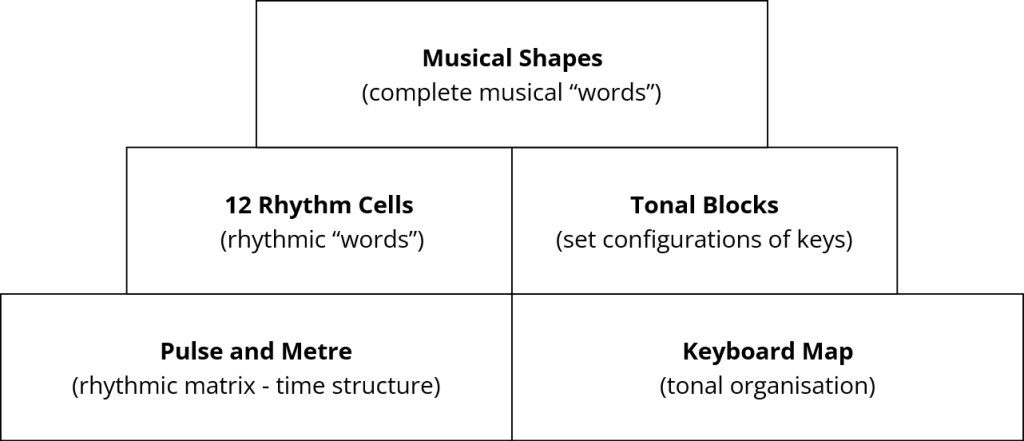
Rhythm is not treated as something to count, or generate mechanically. Instead, it becomes something structurally stable and flexible. You can know it reliably. You can feel it and express it very deeply: a clear, unfolding, elastic beat structure, groove or metre, that houses rhythmic cells, creates a sense of flow and storytelling that carries the music forwards effortlessly.
With this ground of metre – a rhythmic matrix – to carry you, you don't need to manage your performance. Instead you learn to trust the underlying structure of rhythm and let simple patterns form and sit naturally within it.
Understanding the keyboard clearly
At the same time, the keyboard stops being a collection of separate notes. It begins to appear as a clear layout, with beautiful symmetry. Using tonal blocks – fixed configurations of keys – you can know precisely where you are within this whole, interlocking, symmetric tonal structure, rather than searching for individual notes. This makes it much easier to:
- move around the keyboard with intention and accuracy
- grasp the relationships between tonal sounds
- and remain physically relaxed and grounded as you play
These blocks are not theoretical elements, they are physical, embodied configurations that resonate deeply and meaningfully. The harmonic blocks specifically provide a solid grounding for your natural musical ear to adhere to. They are already familiar as tonal sounds on an intuitive level and with practice, you can summon them on demand as meaningful tonal places that we inhabit.
Bringing the elements together—the model
When rhythm and tonality are combined, something very natural begins to happen. The rhythmic cells move through the tonal blocks, and form musical shapes—small, complete units of music that can be heard, felt, and played. By experimenting playfully, you generate endless permutations and experience or "say" them directly. This is how music starts to be a language, rather than a set of instructions.
Keep it simple, stay with it, let the complexity evolve, stop managing results
A key part of the process is not making things too complicated too quickly. Clarity of focus moment by moment matters. With practice, you will be able to process the elements of this model very rapidly, meaning that you can understand music in real time. Instead of assessing how elaborate the material is, assess how clearly you can stay with the basic elements, using them to play something meaningful, intentional and simple. Practising in this way means the model will become internalised, embodied and alive.
Sometimes, this can feel slightly exposed, as if you are no longer “hiding” behind complexity or your sense of aesthetics or design. But loosening your grip on those handrails of safety and control is how it feels when clarity of musical understanding and natural, unforced expression begin to emerge. You let yourself move away from managing results into fluent communicating.
As the structures and elements become deeply familiar, and your focus sustains successfully, allowing you to monitor musical "vocabulary" rapidly in real time, you will realise that the mental effort on managing the musical performance would simply interfere with this fluent process. With no need to think about notes, technique, theory, performance criteria, no need to hear the music in terms of "how it goes" or how good it sounds, you can trust and follow the unfolding shape of the music, moment by moment. It is so important to let go of needing to control the result—our conditioned "karaoke" or mimetic sense of music. It can be hard, even scary to kick this habit. But when we do, the result is a way of playing that feels:
- more connected and embodied
- more responsive and flexible
- more natural, communicative, unforced, even conversational
Rather than trying to produce something good, amazing or just adequate, you "say" what you feel, allowing music to unfold naturally and meaningfully, using the elements you know: tonal blocks and rhythm cells that become shapes, unfolding within the structures that you know—the rhythmic matrix and the keyboard map.
A gradual process
Whilst progress can sometimes be rapid, this way of working is less about progressing quickly, more about deepening or internalising your awareness of musical language. It can take time to release the psychological and emotional resistance to this process—those gremlins that we all have in our heads relentlessly ask us to find hard control of results and approval. So, it can take time, patience and lots of playful, gentle discipline to deepen trust in the model. But once our relationship with the musical language is strong, we can allow ourselves to use it naturally to express feelings.
Over time:
- the keyboard becomes like an extension of the body
- your inner musical ear guides your movements and choices
- and the music you "speak" feels coherent and expressive
What matters most
What makes this approach work is playing natural musical forms that you grasp clearly, whilst allowing them to be deeply meaningful. A small simple musical statement that you understand can express a vast and richly complex feeling. To do this, what matters is:
- staying with the simple foundational elements that form musical language—always developing that focus
- trusting these basic structures and elements to convey real, deep musical messages, rather than seek impressive results
- becoming less perfectionist or controlled and more directly expressive
From there, everything else grows.